Running bulk Instagram DMs in 2026 isn't just a volume game. Instagram's behavioral AI has made raw volume the fastest way to lose accounts. The operators getting results now combine tighter targeting, varied messaging, and smart account management.
Here's the strategy breakdown.
The targeting-volume tradeoff
Higher volume requires looser targeting. Tighter targeting allows better personalization and fewer spam reports. Most successful outreach operators run layered campaigns rather than a single blast:
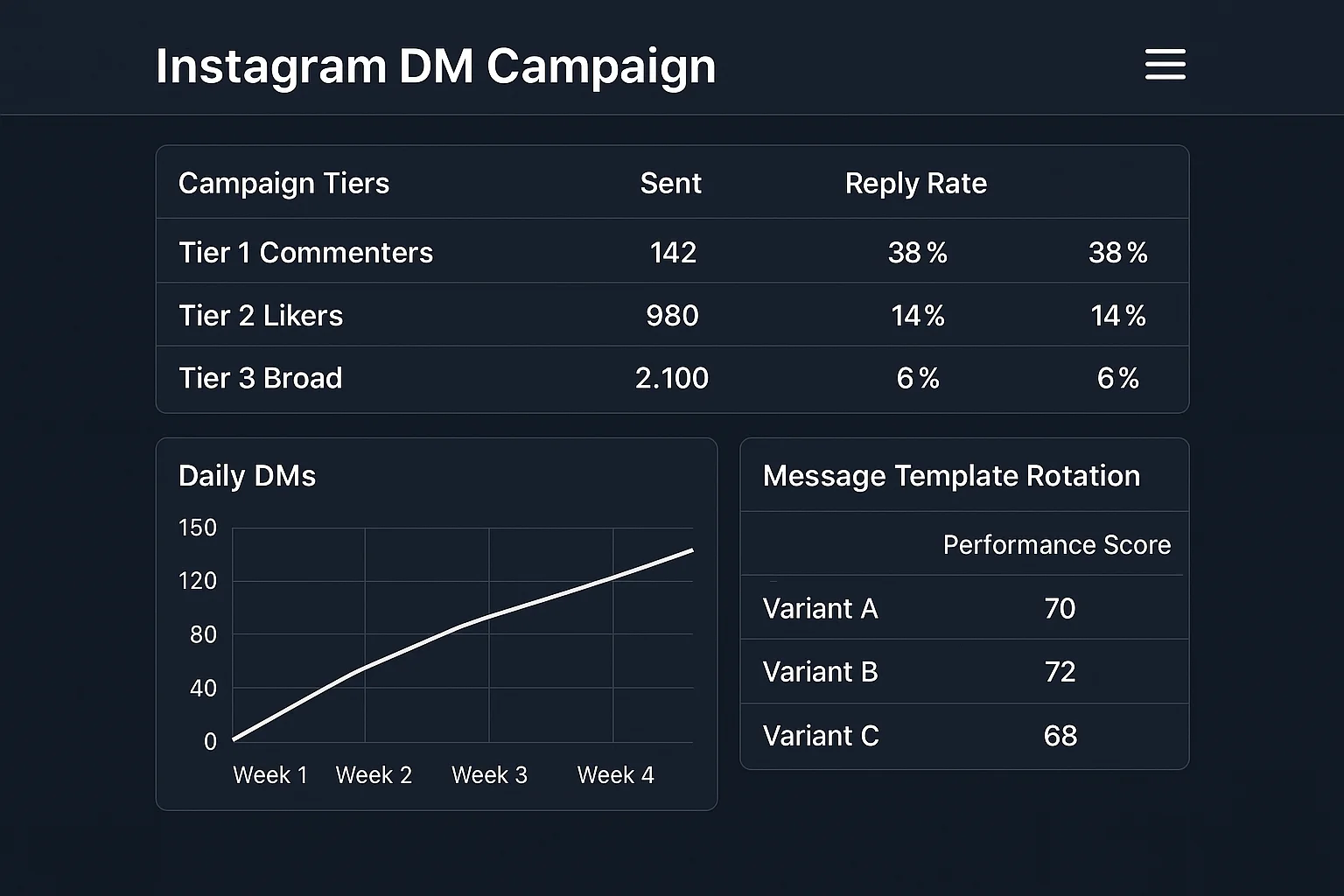
Tier 1 — High-intent, low volume: Commenters on posts in your niche. People who commented on "comment X to get Y" posts are warm — they're already expecting a DM. Reply rates here hit 30–40%.
Tier 2 — Medium-intent: Likers on competitor posts and niche hashtag content. Broader pool, still topic-engaged. Reply rates 10–20% with solid personalization.
Tier 3 — Broad reach: Followers of relevant accounts. Generic audience, needs sharper copy to cut through. Reply rates 5–10%.
Don't put all volume through one tier. Run them as separate campaigns with different messaging per tier.
Account health: the real bottleneck
Your accounts are your infrastructure. Treat them that way.
Account age matters more than ever in 2026:
- Under 30 days old: Max 10–15 cold DMs/day
- 30–180 days: 50–100/day
- 180+ days (aged, active history): 150–200/day
Profile setup before outreach:
- Real profile photo, complete bio, at least 6–9 posts
- Some follower/following activity that looks organic
- At least 2 weeks of account activity before first campaign
Gradual warm-up:
- Week 1: 15 DMs/day
- Week 2: 30/day
- Week 3: 60/day
- Week 4+: Full operational volume
Jumping from 0 to 100 DMs/day on a fresh account is the fastest way to get it flagged.
Message strategy in 2026
Instagram's spam detection now analyzes text patterns across sends. Identical copy flagged repeatedly enough can trigger account-level action, not just message-level filtering.
What works:
- Personalize with at least one specific detail (their niche, a recent post, a mutual connection)
- Keep the first DM under 3 lines — short reads as human
- Ask a question, not make a pitch
- No links in the first message — treated as phishing by Instagram's filters
Template rotation: Don't run one template. Run 3–5 variants and rotate them. Even small wording differences (different opening word, different question phrasing) reduce the behavioral fingerprint.
Example rotation:
Variant A: Hey {username} — saw your content in the [niche] space. Quick question — are you currently doing [X]?

Variant B: {username} — came across your posts about [topic]. Had a question about [related thing]. Would you be open to a quick chat?

Variant C: Hey {username}, your [specific post type] caught my attention. Working with a few people in this space — curious if [relevant question]?
Response handling: don't ignore the backend
Bulk DM is top-of-funnel. The backend matters as much as the sends.
Build a simple response routing system:
- Filter: Separate replies from non-replies automatically (InstaSDM's DM logs give you full visibility)
- Classify: Positive responses vs. objections vs. neutrals
- Route: Positive responses go to a human for follow-up within 2 hours — speed matters here
- Log: Every interaction tracked for campaign iteration
The goal isn't more sends. It's more qualified conversations reaching the right person at the right time.
The 2026 compliance floor
Instagram's enforcement has tightened significantly. The non-negotiables:
- Never exceed 1,000 DMs per account in 24 hours
- No scraped or purchased contact lists — Instagram detects patterns of outreach to non-engaging accounts
- High user report rates trigger automated account review, even from compliant infrastructure
- Randomize delays — fixed-interval sends (every 60 seconds exactly) are a bot signal
Stay within these rails and bulk Instagram DM remains a viable, high-ROI outreach channel in 2026.