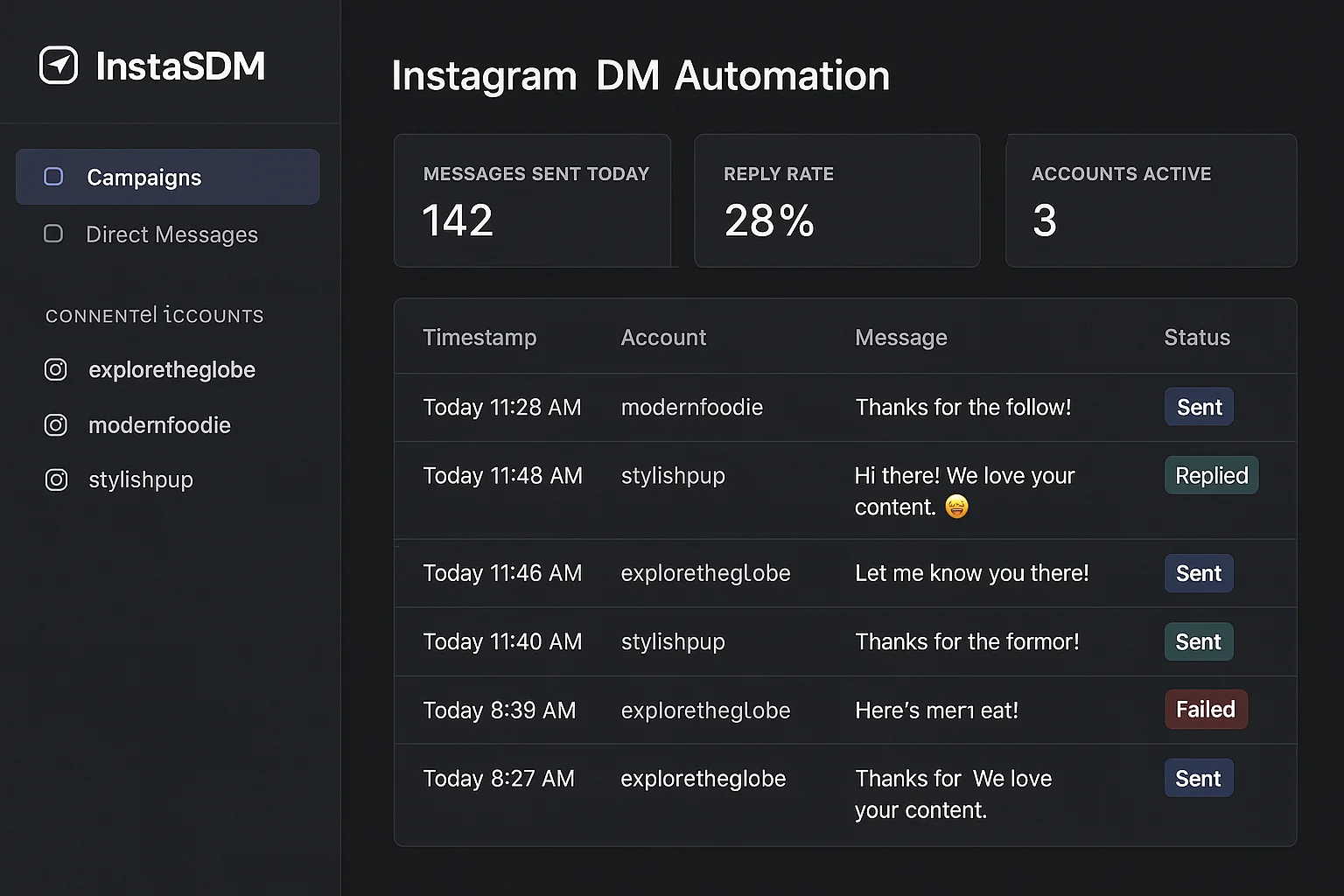
Instagram DM automation has changed significantly by 2026. Meta's detection has matured to the point where the old playbook — browser extensions, Selenium scripts, desktop tools — is effectively dead. Instagram's ML models now analyze behavioral patterns, not just volume, flagging accounts based on send timing, message similarity, IP consistency, and interaction fingerprints.
Here's what the landscape looks like and how to run outreach without wrecking your accounts.
Why browser extensions no longer work
Browser extensions inject JavaScript into Instagram's interface. By 2026, Meta's detection systems can identify the microscopic differences between a real human tapping a screen and a script injecting code into the DOM. The result: no warning, instant ban. Account simply disappears.
Extensions also leave structural problems beyond detection:
- Machine dependency: Your computer must stay on 24/7
- Variable IP: Every router restart or travel session changes your IP
- Single session: One browser, one account at a time
- Silent failures: Browser crashes, Instagram UI updates — campaigns die with no notification
The server-side approach
Server-side Chrome eliminates these problems at the root. Each Instagram account runs in a persistent Chrome profile on a fixed server IP. The browser behaves identically to a long-term human user — consistent fingerprint, consistent IP, persistent cookies and session data.
InstaSDM's architecture runs a dedicated Chrome instance per connected account. When a campaign executes, it navigates the DM interface and types with human-like timing. No extension. No injected JavaScript. No detectable automation surface.
2026 DM limits you need to know
Instagram's limits have tightened and become more nuanced:
| Account Type | Daily DM Cap (Manual) |
|---|---|
| New account (0–30 days) | 5–10 cold DMs |
| Established (30–180 days) | 50–100 |
| Aged account (180+ days) | 150–200 |
Key rules Instagram's behavioral AI watches for in 2026:
- Identical message text across sends — triggers spam pattern detection
- High velocity in short windows — spreading sends across the day matters more than daily totals
- Links in first messages — treated as phishing signals; never include them
- More than 1,000 DMs in 24 hours from a single account — hard limit regardless of tool
Safe send behavior
The behavioral AI looks at patterns, not just numbers. What keeps accounts safe:
- Randomized delays: 45–180 seconds between messages, not a fixed interval
- Message variation: Rotate templates; never send identical copy to every recipient
- Gradual ramp: New accounts start at 15–20/day for two weeks minimum
- Spread throughout the day: Avoid batch-sending in a single hour
- No links in first message: Save URLs for replies and follow-ups
Lead sourcing in 2026
High-intent targeting dramatically reduces spam reports, which is now one of the primary ban triggers:
- Comment trigger leads — Users who commented on posts asking to "DM for X" are warm and expecting outreach. Highest reply rates.
- Likers on competitor content — Engaged with your niche, lower intent than commenters
- Story reply openers — Reply to a story from your target account to start a conversation naturally
- Hashtag followers — Broad, useful for volume campaigns with tighter message quality
Avoid scraped or purchased lists. Instagram detects and penalizes outreach to accounts that have never interacted with your niche.
Message templates that convert
The first DM goal is a reply — not a sale. Short, specific, human:
Hey {username} — noticed your post about [specific topic]. Had a quick question about [relevant angle]. Worth a minute?
Personalize with at least one profile-specific detail. Generic openers get ignored or reported. According to 2026 industry data, personalized DM outreach achieves around 32% reply rates versus 18% for generic cold messages.
Conclusion
Instagram DM automation is viable in 2026 with the right infrastructure: server-side execution, persistent sessions, randomized human-like behavior, and conservative warm-up ramps. The tools that survive Meta's detection are the ones that look and behave like real users at the infrastructure level — not the ones bolted onto a browser.
InstaSDM is built on this architecture. Your campaigns run while your laptop is closed.